


Model#
REHO models urban energy systems at three nested scales, each building on the previous one. The core idea is the energy hub concept: a set of conversion and storage technologies that interface local resources and imported energy supplies with end-users’ energy services. The three models are interdependent.
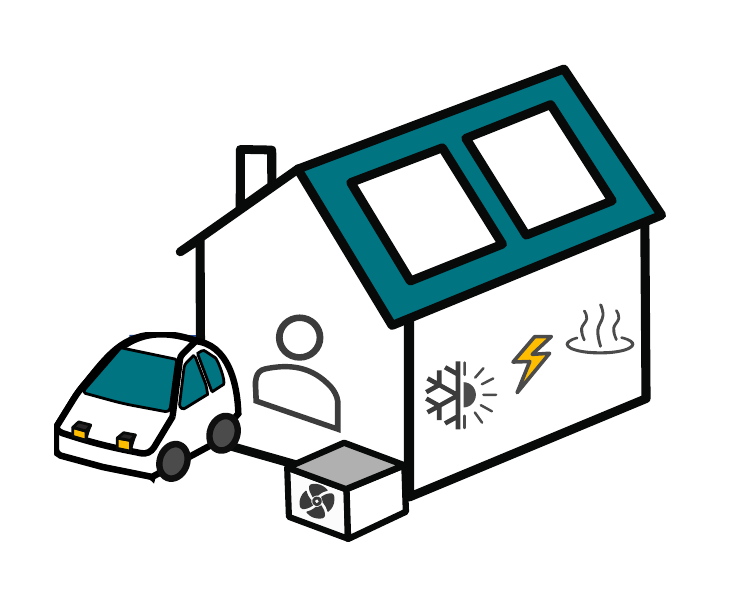
Single-building MILP for optimal design and operation of energy conversion and storage technologies. Includes thermal dynamics, multi-objective optimization, and renovation.
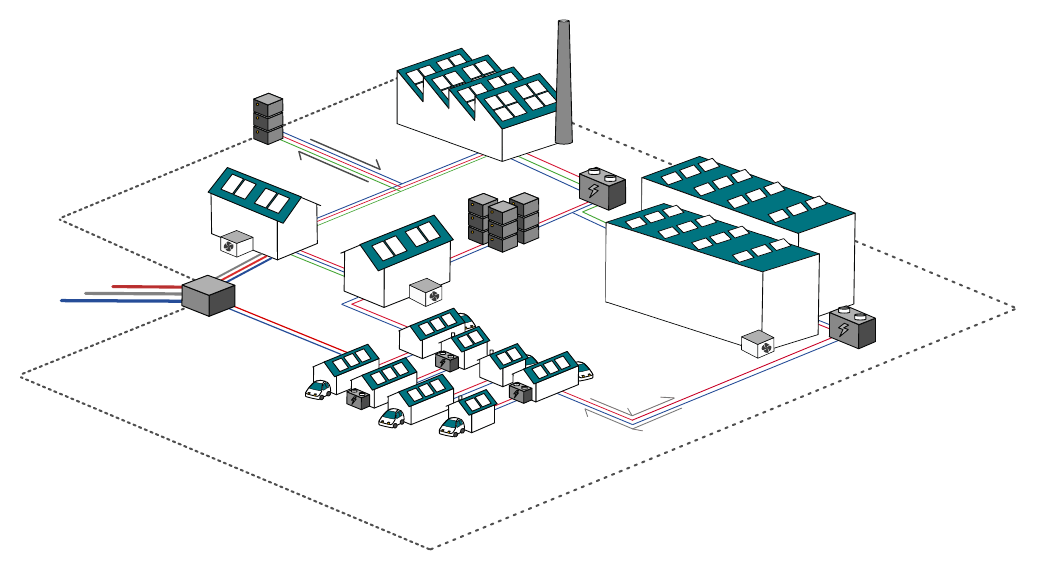
Dantzig–Wolfe decomposition for communities of buildings. Adds district heating/cooling networks, local mobility services, and grid reinforcement decisions.
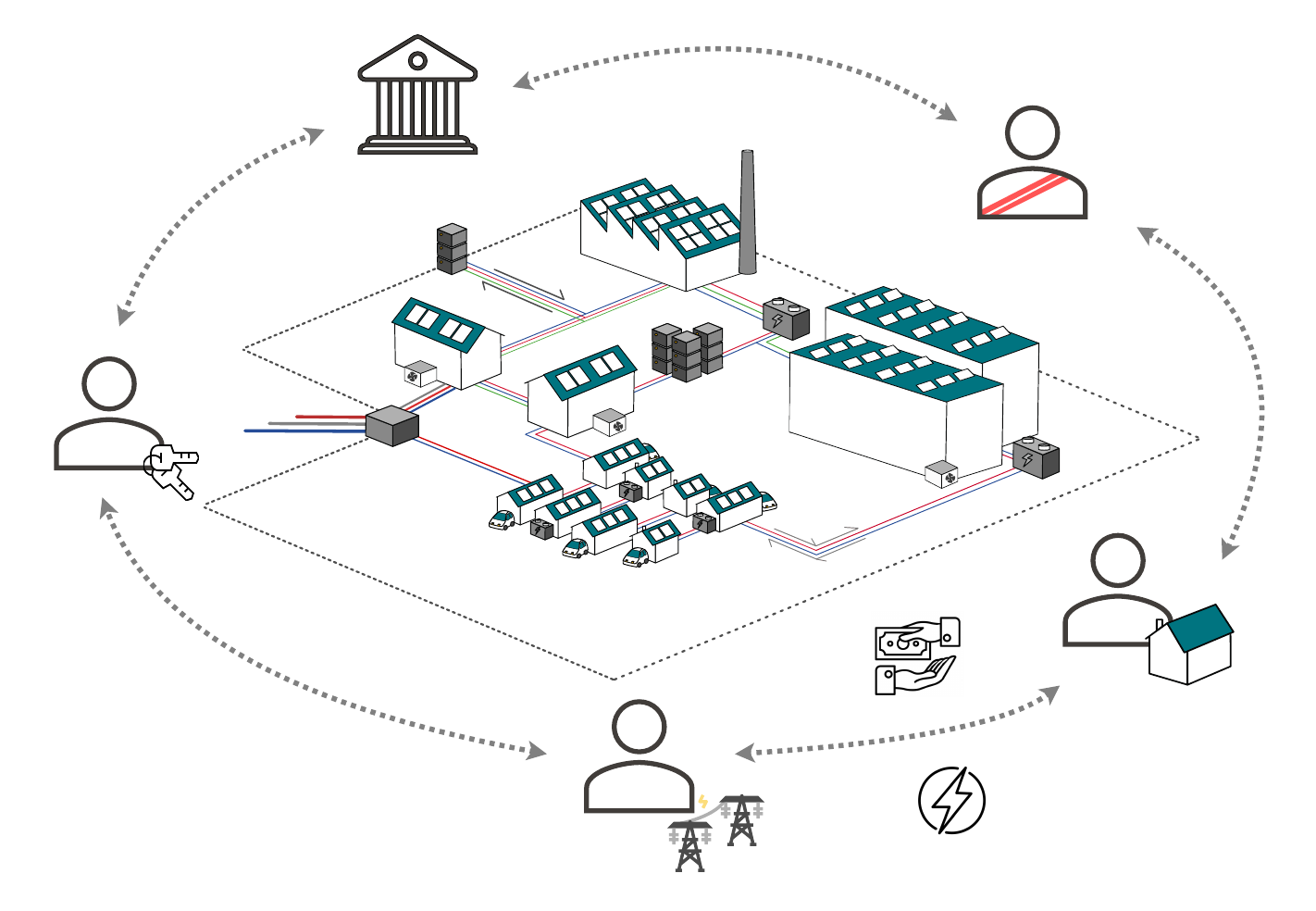
Multi-actor framework layered on the district model. Represents tenants, landlords, energy community manager, DSO, and authorities with individual economic constraints.
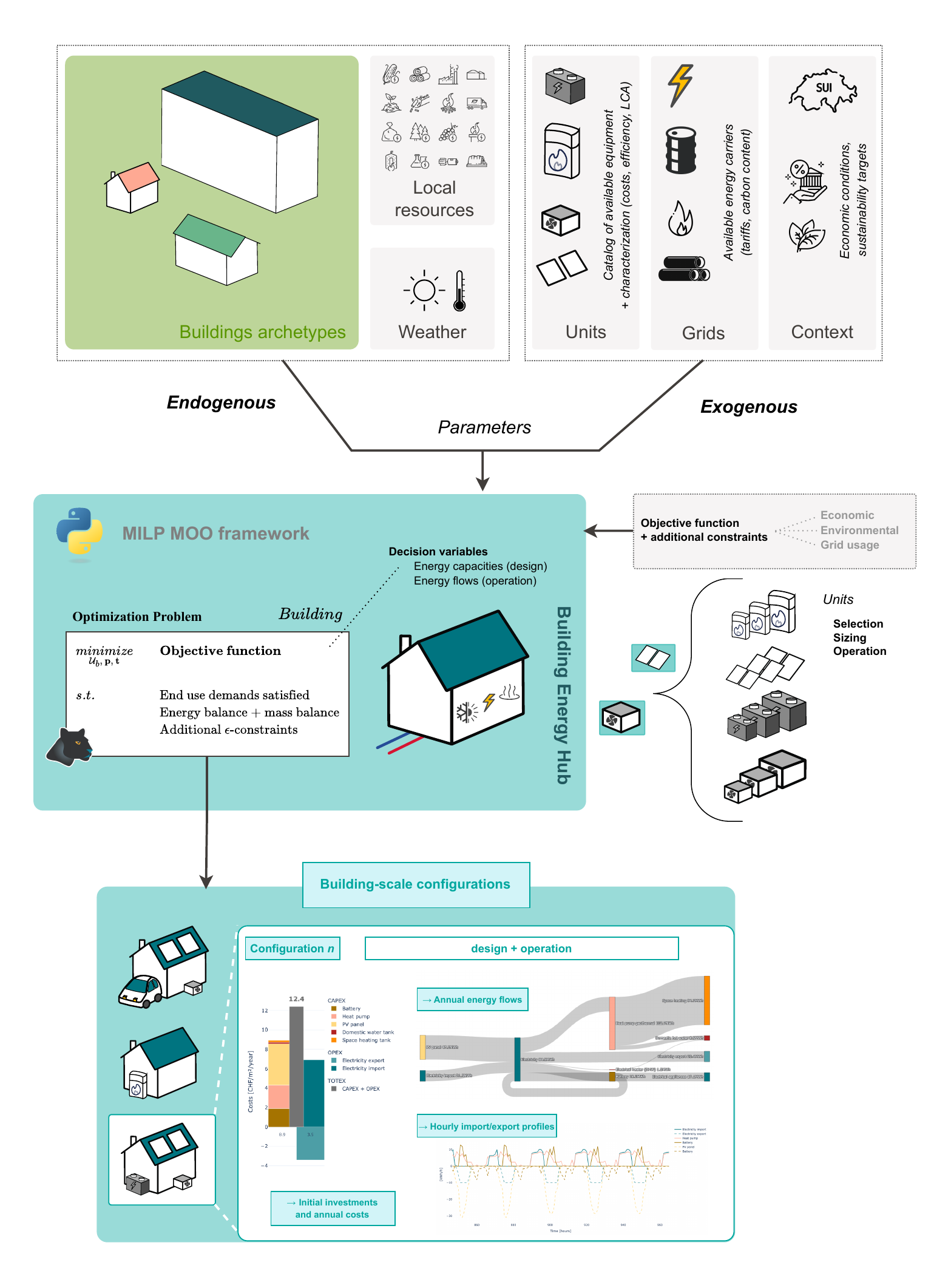
Building model · click to zoom
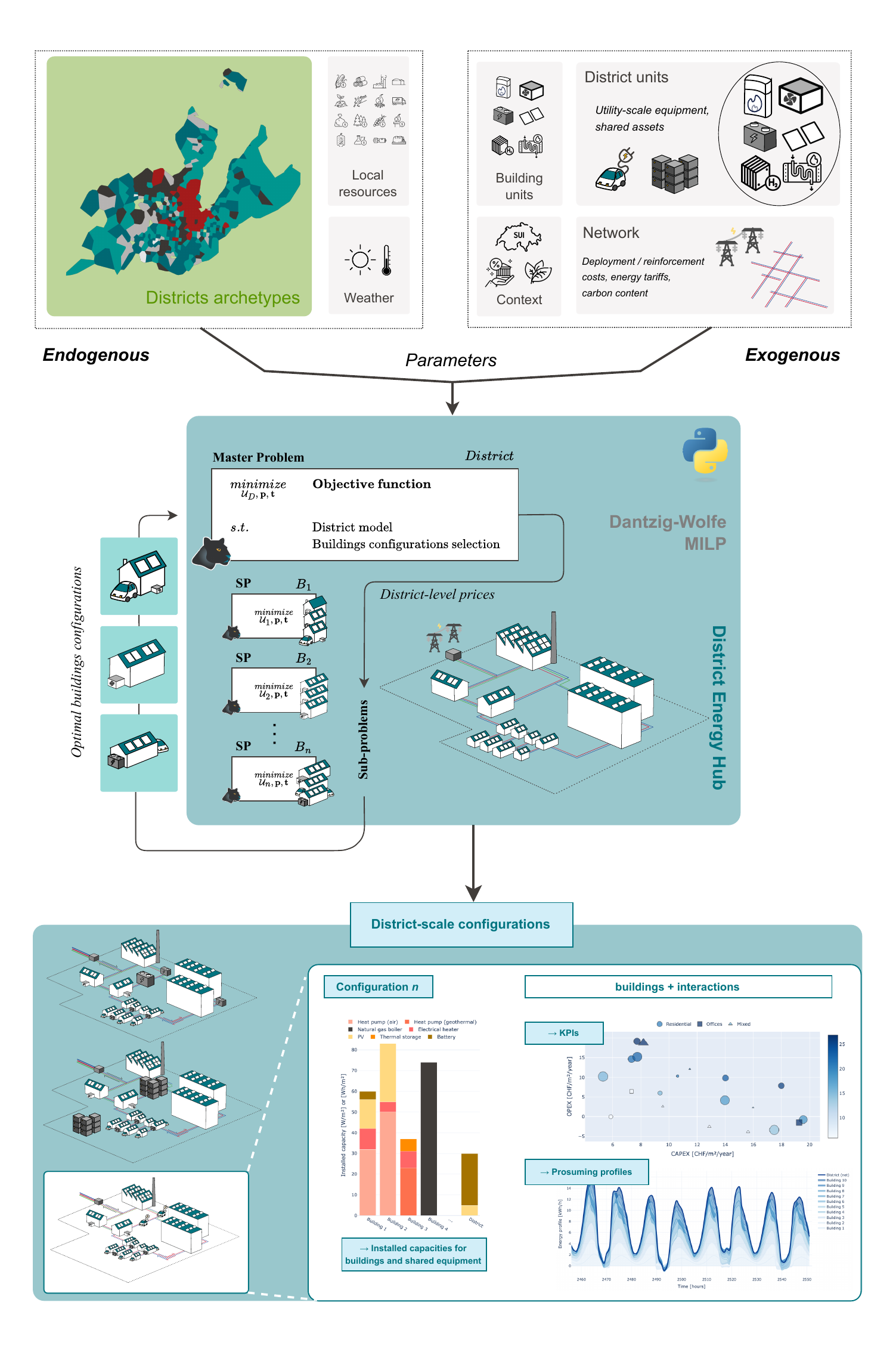
District model · click to zoom
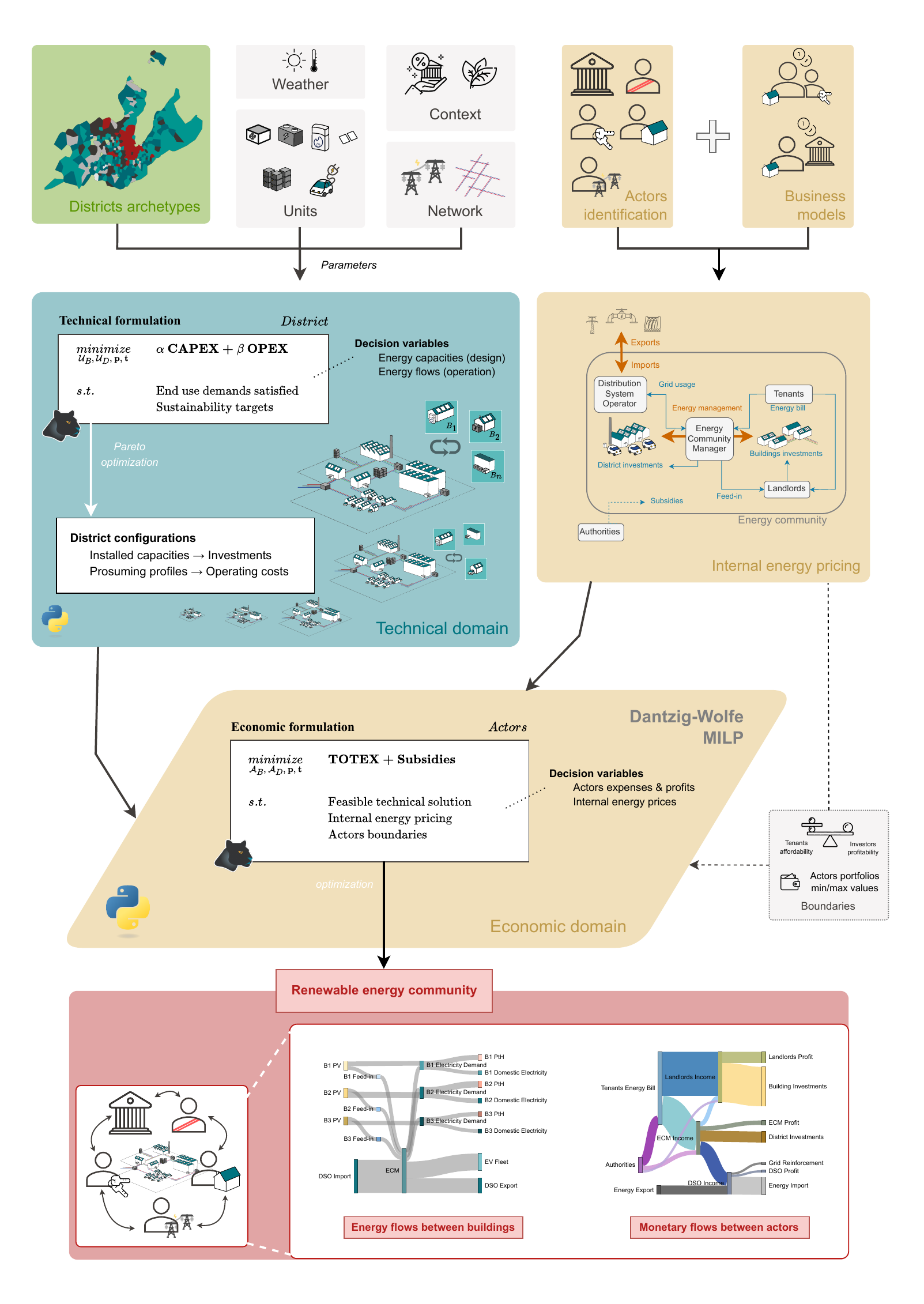
Actors model · click to zoom
Reference thesis
D. Lepour, Renewable Energy Communities for the Energy Transition, EPFL, 2026. → Full text on Infoscience
The three models documented here are described exhaustively in the manuscript, with full equations, figures, and methodological details: Chapter 2 covers the Building model, Chapter 3 the District model, and Chapter 4 the Actors model.
Notation convention#
The following typographic conventions are used throughout the model documentation:
Convention |
Meaning |
|---|---|
Bold variable, e.g. \(\boldsymbol{f}_{b,u}\) |
Optimization decision variable |
Regular, e.g. \(F_u^{\max}\) |
Fixed parameter |
\(\dot{E}\) |
Power [kW] |
\(E\) |
Energy [kWh] |
\(\dot{Q}\) |
Thermal power in the heat cascade [kW] |
Superscript \(+\) |
Outgoing flow (supply, production, export) |
Superscript \(-\) |
Incoming flow (demand, consumption, import) |
Index sets used across all scales:
Set |
Symbol |
Description |
|---|---|---|
Buildings |
\(\mathbb{B}\) |
\(b \in \mathbb{B}\) |
Energy layers |
\(\mathbb{L}\) |
\(l \in \mathbb{L}\) |
Technologies |
\(\mathbb{U}\) |
\(u \in \mathbb{U}\) |
Typical periods |
\(\mathbb{P}\) |
\(p \in \mathbb{P}\) |
Timesteps |
\(\mathbb{T}\) |
\(t \in \mathbb{T}\) |
Configurations |
\(\mathbb{F}\) |
\(f \in \mathbb{F}\) (district scale) |
District units |
\(\mathbb{U_D}\) |
\(u_d \in \mathbb{U_D}\) (district scale) |